Common AI Myths You Should Stop Believing
Artificial Intelligence (AI) is one of the fastest-growing technologies in the world. From ChatGPT and AI image generators to business automation and smart assistants, AI is becoming part of our daily lives.
However, along with its popularity, many myths and misunderstandings have also spread.
Some people think AI will replace every human job. Others believe AI is always correct or that only software engineers can use it.
The truth is very different.
In this beginner-friendly guide, we’ll uncover the most common AI myths, explain the facts with simple examples, and help you understand how AI is really changing the world.
Why Do AI Myths Spread?
Whenever a new technology becomes popular, people often misunderstand how it works.
Movies, social media, and sensational headlines sometimes create unnecessary fear or unrealistic expectations.
In simple Hindi:
“Jitni fast AI technology grow ho rahi hai, utni hi fast uske baare mein galat information bhi spread ho rahi hai.”
Understanding the facts helps you use AI confidently and responsibly.
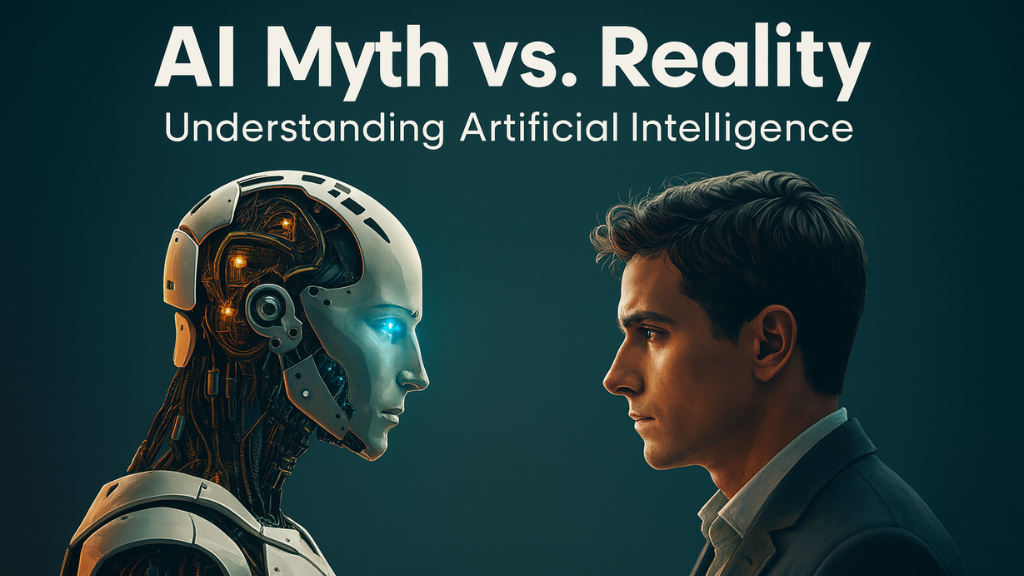
Common AI Myths vs Reality
| Myth | Reality |
|---|---|
| AI will replace every job | AI automates tasks, not every profession. |
| AI is always correct | AI can make mistakes and should be verified. |
| Only programmers can learn AI | Anyone can learn AI tools with practice. |
| AI can think like humans | AI predicts patterns but does not think or feel like humans. |
| AI will stop human creativity | AI supports creativity but does not replace original human ideas. |
Myth 1: AI Will Replace Every Job
This is one of the biggest myths.
The reality is that AI mainly automates repetitive and time-consuming tasks.
For example:
- Writing first drafts
- Organizing data
- Customer support automation
- Report generation
But jobs involving creativity, leadership, emotional intelligence, teaching, healthcare, and strategic decision-making still require human expertise.
Real-Life Example
A digital marketer uses AI to generate campaign ideas in minutes. However, deciding the final marketing strategy, understanding customer emotions, and building brand trust still require human skills.
Myth 2: AI Is Always Correct
Many beginners believe AI never makes mistakes.
This is false.
AI generates responses based on patterns in data, but it can:
- Provide outdated information
- Misunderstand prompts
- Produce incorrect facts
- Miss important context
Always verify AI-generated content before using it for business, education, or professional work.
Myth 3: Only Programmers Can Learn AI
Years ago, learning AI required advanced coding knowledge.
Today, many AI tools are designed for everyone.
Students, teachers, freelancers, marketers, entrepreneurs, designers, and business owners can all use AI without programming.
Learning how to write effective prompts is often more important than writing code.
Myth 4: AI Can Think Like Humans
AI can answer questions, generate images, and write articles, but it does not have emotions, consciousness, or personal experiences.
It predicts the most likely response based on patterns—it doesn’t “understand” the world the way humans do.
This is why human judgment remains essential.
Myth 5: AI Will Kill Creativity
Some people worry that AI will eliminate creativity.
In reality, AI acts more like a creative assistant.
It can help with:
- Brainstorming ideas
- Creating outlines
- Designing rough concepts
- Writing first drafts
The final creativity still comes from human experience, imagination, and decision-making.
Myth 6: AI Is Only for Big Companies
This is another common misconception.
Today, even small businesses use AI for:
- WhatsApp automation
- Social media content
- Email marketing
- Customer support
- Website content
- Appointment scheduling
AI is becoming affordable and accessible for businesses of every size.
Latest AI Trends in 2026
Artificial Intelligence is evolving rapidly.
Some important trends include:
- AI Agents managing complete business workflows
- Multimodal AI working with text, images, audio, and video
- AI-powered website development
- AI business automation
- Personalized AI tutors
- AI coding assistants
- Voice-based AI assistants
- Responsible AI focusing on transparency, security, and ethical use
Understanding these trends helps separate real innovation from exaggerated claims.
Actionable Tips for Using AI Wisely
Learn the Basics
Understand what AI can and cannot do.
Write Better Prompts
Clear instructions produce better results.
Verify Information
Double-check important facts before publishing or making decisions.
Keep Learning
AI tools evolve quickly, so update your knowledge regularly.
Combine AI with Human Skills
Creativity, communication, empathy, and critical thinking make AI-generated work more valuable.
Common Mistakes to Avoid
- Trusting every AI response without verification
- Depending completely on AI
- Ignoring privacy while using AI tools
- Using AI-generated content without editing
- Believing social media myths instead of learning from trusted sources
Real-Life Success Story
Rohit runs a small digital marketing agency.
Initially, he feared AI would replace his work.
Instead, he learned AI content creation, prompt engineering, SEO, and automation.
Today, his team delivers projects faster, serves more clients, and spends more time on creative strategy rather than repetitive tasks.
AI didn’t replace his business—it helped it grow.
FAQs
1. Will AI replace all jobs?
No. AI automates many tasks, but human creativity, leadership, and decision-making remain essential.
2. Is AI always accurate?
No. AI can make mistakes and should always be reviewed.
3. Can non-technical people learn AI?
Yes. Many modern AI tools are designed for beginners with no coding experience.
4. Does AI reduce creativity?
No. AI helps generate ideas, but human creativity is still required to create meaningful and original work.
5. Is AI safe for businesses?
Yes, when used responsibly with proper security, privacy, and human oversight.
6. Can students benefit from AI?
Absolutely. AI supports learning, research, writing, presentations, and productivity.
7. What industries use AI?
Healthcare, finance, education, retail, manufacturing, marketing, logistics, customer service, and many more.
8. What’s the best way to learn AI?
Start with AI fundamentals, practice using AI tools, learn prompt engineering, build practical projects, and keep improving your skills.
Conclusion
Artificial Intelligence is one of the most exciting technologies of our time, but understanding the facts is just as important as learning the tools.
Most AI myths come from misunderstanding or unrealistic expectations. The truth is that AI is designed to assist people—not replace human intelligence, creativity, or judgment.
The future belongs to people who learn how to work with AI effectively while continuing to develop their own unique skills.
Learn Practical AI Skills with DigiAI Technologies
Ready to move beyond AI myths and build real-world skills?
DigiAI Technologies offers practical, industry-focused training programs designed for students, professionals, freelancers, entrepreneurs, and business owners.
Our programs include:
- AI Professional Courses
- AI Content Creation Training
- Digital Marketing Training
- Website Development Courses & Services
- Business Automation Solutions
- Prompt Engineering Workshops
- AI Productivity Tools Training
- Career-Oriented AI Learning Programs
Whether you want to advance your career, grow your business, or become confident using AI in everyday work, DigiAI Technologies provides hands-on learning with real-world applications.
Join DigiAI Technologies today and turn AI knowledge into practical career success.