Running a small business is not easy.
A business owner may have to manage customers, sales, marketing, employees, social media, accounts, website updates, and daily operations—often with a very small team.
This is where Artificial Intelligence (AI) can make a real difference.
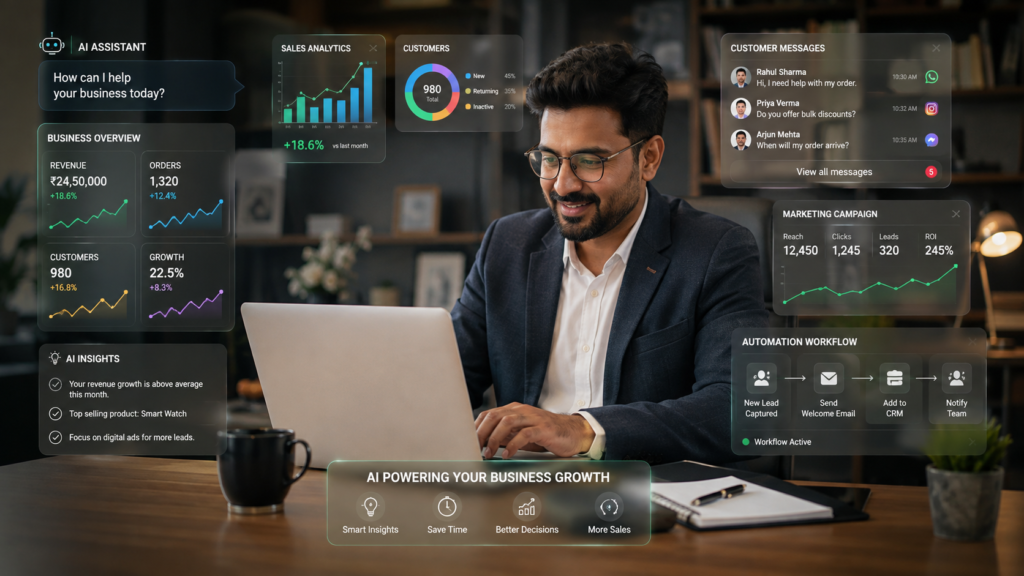
AI is no longer only for large technology companies. Small businesses can now use AI-powered tools to save time, automate repetitive work, understand customers, create content, improve marketing, and make better business decisions.
Recent research also shows that AI adoption among small and medium businesses is increasing. Google reported in 2026 that more than 80% of small businesses using AI in a cited U.S. Chamber of Commerce study reported improvements such as higher sales, profits, or team growth. Salesforce’s 2026 research also found strong AI adoption among Indian SMBs.
The important point is this:
AI does not have to replace your team. It can help your existing team do more with the same time and resources.
Why Small Businesses Should Learn AI
Large companies often have dedicated marketing teams, customer-support departments, analysts, and IT professionals.
A small business may have only two or three people handling all these responsibilities.
AI can help reduce that gap.
In simple Hindi:
“AI aapke business ka replacement nahi, balki ek smart digital assistant ban sakta hai.”
With the right implementation, AI can help a business:
- Save time
- Reduce repetitive work
- Improve customer response
- Create content faster
- Generate and organize leads
- Improve marketing
- Analyze business data
- Automate workflows
- Provide better customer experiences
- Scale without immediately increasing operational workload
10 Ways AI Helps Small Businesses Grow
1. AI-Powered Customer Support
Customers often want answers immediately.
AI chatbots and assistants can handle common questions about:
- Products
- Services
- Prices
- Business hours
- Appointments
- Delivery information
- Frequently asked questions
This allows customers to receive basic support even outside normal business hours.
However, complex or sensitive issues should still be transferred to a human employee.
2. AI for Digital Marketing
Marketing requires consistent content.
AI can help businesses create first drafts for:
- Social media posts
- Blog articles
- Email campaigns
- Ad copy
- Product descriptions
- Video scripts
- Content calendars
For example, a local salon can use AI to create a monthly social media content plan instead of starting from a blank page every morning.
The business owner still decides the offers, brand message, and final content.
3. AI for Lead Generation
Getting leads is important, but managing every lead manually can consume a lot of time.
AI can help organize leads based on:
- Customer interest
- Previous interaction
- Location
- Product requirement
- Buying stage
It can also assist with follow-up messages and reminders.
This means sales teams can spend more time speaking with serious prospects instead of manually sorting every inquiry.
4. Business Automation
One of the biggest opportunities for small businesses is automation.
AI-powered workflows can help connect different business activities.
For example:
Website enquiry → Lead captured → CRM updated → Follow-up message → Appointment scheduled → Reminder sent
Instead of employees performing every step manually, software can automate parts of the workflow.
Modern business platforms are increasingly making AI-agent and workflow automation accessible without requiring advanced coding skills.
5. AI for Website Development
A professional website is important for building trust online.
AI can assist with:
- Website content
- Landing-page ideas
- SEO structure
- Code generation
- FAQ creation
- Product descriptions
- User-experience suggestions
- Website troubleshooting
This does not mean a business should blindly publish AI-generated material.
Human review is still necessary to make sure the website accurately represents the company.
6. AI for Sales
AI can support sales teams by helping them understand customers and prioritize opportunities.
For example, AI can help identify:
- Frequently interested customers
- Leads that need follow-up
- Common objections
- Frequently requested products
- Sales trends
AI can also help sales professionals prepare personalized communication.
The goal is not simply to send more messages.
The goal is to make customer communication more relevant and timely.
7. AI for Data Analysis
Small businesses generate valuable data every day.
Examples include:
- Sales
- Website visitors
- Customer enquiries
- Advertising results
- Inventory
- Expenses
- Repeat purchases
AI tools can help turn this information into understandable insights.
Instead of looking through hundreds of spreadsheet rows, a business owner can ask questions such as:
“Which product generated the highest sales this month?”
or
“Which marketing campaign generated the most enquiries?”
This can make business decisions faster and more data-driven.
8. AI for Content Creation
Creating professional content can be difficult for a small team.
AI can help with:
- Images
- Videos
- Presentations
- Blog outlines
- YouTube scripts
- Product descriptions
- Marketing ideas
For example, a small restaurant can use AI to develop a weekly content plan around its menu, customer reviews, seasonal offers, and local events.
The business’s own photos, experiences, and expertise should remain at the center of the content.
9. AI for Productivity
AI can reduce the amount of time spent on administrative work.
It can assist with:
- Meeting summaries
- Email drafts
- Document summaries
- Spreadsheet analysis
- Task planning
- Research
- Presentation preparation
This gives business owners more time for activities that directly contribute to growth.
10. AI-Powered Personalization
Customers increasingly expect businesses to understand their needs.
AI can help personalize:
- Product recommendations
- Email communication
- Offers
- Follow-ups
- Website experiences
- Customer support
But personalization works best when businesses have clean and relevant customer data.
In 2026, Salesforce reported that Indian marketers are increasingly adopting AI, while data quality and disconnected systems remain important challenges.
AI for Small Business: Quick Comparison
| Business Area | Traditional Approach | With AI Assistance |
|---|---|---|
| Content | Create everything manually | Generate drafts and ideas faster |
| Customer Support | Staff handles every query | AI handles routine questions |
| Lead Management | Manual sorting | Automated organization and follow-up |
| Marketing | Manual research | AI-assisted research and planning |
| Data Analysis | Manual spreadsheet review | Faster insight generation |
| Website | Longer development process | AI-assisted content and development |
| Administration | Repetitive manual tasks | Automated workflows |
Real-Life Example
Imagine Neha runs a small clothing boutique.
She has three employees and receives customer enquiries through Instagram, WhatsApp, and her website.
Earlier, her team spent several hours every week:
- Answering repetitive questions
- Writing social media posts
- Following up with customers
- Updating product information
- Preparing basic sales reports
Neha introduces AI gradually.
Now:
- AI helps draft social media content.
- Automated workflows organize enquiries.
- Customer FAQs receive instant responses.
- AI helps summarize sales data.
- Her team spends more time on customers and sales.
The important lesson is that Neha did not automate everything at once.
She identified repetitive tasks first and then introduced AI where it created measurable value.
Latest AI Trends for Small Businesses in 2026
The AI landscape is moving from simple chatbots toward systems that can assist with complete workflows.
AI Agents
AI agents can plan and execute multiple steps rather than simply answering a single question. Businesses are increasingly exploring these systems for sales, service, marketing, and operations.
Multimodal AI
Modern AI can work across text, images, audio, and video, creating new possibilities for marketing, customer support, training, and content creation.
AI-Powered Marketing
Businesses are using AI to create more personalized campaigns and improve customer engagement.
AI Business Automation
AI is increasingly being connected with CRM, email, spreadsheets, websites, and other business systems to automate workflows.
Human + AI Collaboration
The strongest approach is often not “AI instead of people,” but people using AI effectively.
How to Start Using AI in Your Small Business
Don’t buy ten AI tools on day one.
Follow a simple process.
Step 1: Identify Repetitive Tasks
Write down tasks your team performs every day or every week.
Step 2: Choose One Problem
For example:
“We spend too much time answering repetitive customer questions.”
Step 3: Test One AI Solution
Start with a small pilot.
Step 4: Measure the Result
Track:
- Time saved
- Cost saved
- Leads generated
- Customer response time
- Sales improvement
Step 5: Expand Gradually
If the solution works, connect it with other workflows.
Important: AI Needs Human Oversight
AI can be powerful, but it is not perfect.
Businesses should review AI output for:
- Incorrect information
- Brand mistakes
- Privacy concerns
- Security risks
- Misleading claims
- Poor customer communication
Never put sensitive customer or business information into an AI tool without understanding its privacy and data-handling policies.
FAQs
1. Can small businesses use AI?
Yes. AI tools can help small businesses with marketing, customer service, sales, content creation, data analysis, and automation.
2. Is AI expensive for small businesses?
Not necessarily. Many tools offer free or affordable entry-level options. Businesses should start with a specific problem rather than purchasing multiple tools without a clear purpose.
3. Can AI increase sales?
AI can support sales through lead prioritization, personalization, follow-ups, customer insights, and faster marketing execution. However, results depend on the business strategy and implementation.
4. Can AI replace employees in small businesses?
AI can automate certain repetitive tasks, but businesses still need people for judgment, relationships, creativity, strategy, and customer trust.
5. Can AI help local businesses?
Yes. Local businesses can use AI for social media, customer enquiries, appointment management, reviews, website content, lead follow-ups, and marketing.
6. Can AI create content for my business?
Yes. AI can assist with blogs, social posts, emails, videos, images, and other content. Human editing and fact-checking are important.
7. Do I need coding knowledge to use AI?
No. Many modern AI tools are designed for non-technical users. Coding can be useful for advanced automation and development, but it is not necessary for getting started.
8. What is the best way to start using AI?
Choose one repetitive business problem, test one suitable AI solution, measure the result, and expand gradually.
Conclusion
AI is changing the competitive landscape for small businesses.
The biggest opportunity is not simply using AI to create content or answer questions. The real advantage comes from using AI strategically across marketing, sales, customer service, data, websites, and business automation.
Small businesses don’t need a huge technology budget to begin.
Start small. Solve one real problem. Measure the result. Then scale what works.
In simple words:
AI can help a small business operate with the efficiency of a much larger team—when it is implemented thoughtfully and responsibly.
Grow Smarter with DigiAI Technologies
Want to learn how to use AI practically for your career or business?
DigiAI Technologies provides practical AI education, digital solutions, and business-focused training designed for students, professionals, freelancers, entrepreneurs, and small-business owners.
Our programs and services include:
- AI Professional Courses
- AI Content Creation Training
- Digital Marketing Training
- Website Development Courses & Services
- Business Automation Solutions
- Prompt Engineering Training
- AI Productivity Tools
- Career-Oriented AI Learning Programs
Whether you want to automate repetitive work, improve your digital marketing, build a professional website, or develop future-ready AI skills, DigiAI Technologies can help you move from learning AI to actually using AI.
Start your AI journey today and discover how smarter technology can help you work better, grow faster, and stay future-ready.