
Having a website or social media page does not automatically bring customers.
A business can have thousands of followers and still struggle to generate enquiries.
On the other hand, a small business with a well-designed website, useful content and a clear lead-generation system can consistently attract potential customers.
This brings us to an important question:
How can you generate leads online without simply posting advertisements everywhere?
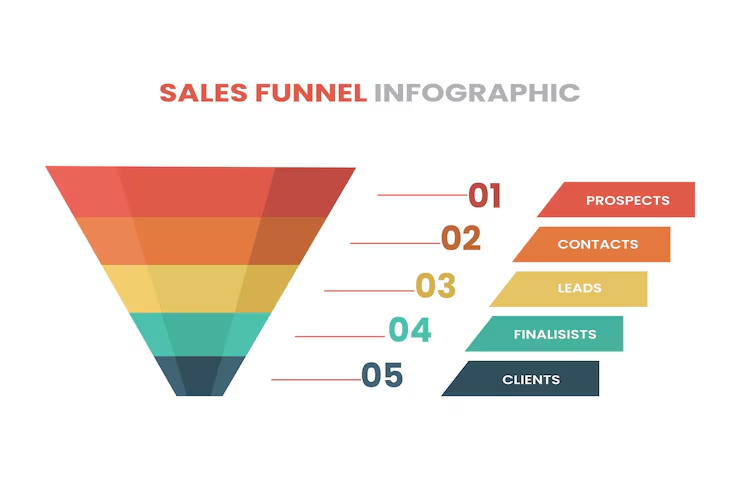
The answer is to build a system that takes a person from discovering your business to becoming an interested prospect.
For example:
Google Search → Website → Useful Information → Enquiry Form → Follow-up → Customer
That is an online lead-generation funnel.
What Is an Online Lead?
A lead is a person or business that has shown interest in your product or service and has provided some form of contact or enquiry information.
Examples include someone who:
- Fills out a website form
- Sends a WhatsApp message
- Requests a quotation
- Books an appointment
- Calls your business
- Downloads a useful resource
- Sends a social media enquiry
Not every lead will become a customer.
That is completely normal.
The objective is to attract relevant leads, not simply collect hundreds of random phone numbers.
How Online Lead Generation Works
A simple lead-generation system looks like this:
Traffic → Attention → Trust → Offer → Lead → Follow-up → Conversion
Let’s understand each stage.
1. Traffic
First, people need to discover your business.
Traffic can come from:
- Google Search
- Social media
- YouTube
- Online advertising
- Referral websites
- Direct traffic
2. Attention
Your content needs to give people a reason to stop and pay attention.
For example:
Instead of saying:
“We provide digital marketing services.”
Try:
“5 Reasons Your Website Is Getting Visitors but No Enquiries.”
The second message addresses a specific problem.
3. Trust
People rarely buy immediately from an unknown business.
Build trust through:
- Educational content
- Reviews
- Testimonials
- Case studies
- Portfolio
- Certifications
- Demonstrations
- Clear business information
4. Offer
Give visitors a clear next step.
Examples:
- Book a consultation
- Request a quote
- Get a free assessment
- Download a guide
- Schedule a demo
- Send a WhatsApp enquiry
5. Lead Capture
Make it easy for the interested person to contact you.
Use:
- Website forms
- Phone calls
- Appointment booking
- Lead forms
7 Effective Ways to Generate Leads Online
1. Build a Lead-Generating Website
Your website should not simply look attractive.
It should guide visitors toward taking action.
Important elements include:
- Clear headline
- Strong value proposition
- Services/products
- Benefits
- Testimonials
- Portfolio
- FAQs
- Contact form
- WhatsApp button
- Call-to-action
For example:
“Need a Professional Business Website?”
Then:
“Get a Mobile-Friendly Website Designed for Your Business.”
Then:
[Request a Consultation]
The visitor immediately understands what you offer and what to do next.
2. Use SEO to Attract High-Intent Visitors
SEO can help you appear when people actively search for solutions.
For example, a website-development company might target searches such as:
- Website developer in Bhilai
- Business website development
- WordPress website developer
- Affordable website development
- Professional website design
The key is search intent.
Someone searching:
“What is a website?”
may only be researching.
Someone searching:
“Website developer near me”
may be closer to making an enquiry.
Therefore, businesses should create content for different stages of the customer journey.
3. Generate Leads Through Social Media
Social media can turn attention into enquiries when content has a clear purpose.
Useful lead-generation content includes:
Educational Posts
Teach customers something useful.
Problem-Solving Reels
Answer common customer problems.
Testimonials
Show real customer experiences.
Case Studies
Explain how you solved a specific problem.
Offer-Based Content
Give interested customers a clear next step.
For example:
“Want to know whether your business needs a website? Send us ‘WEBSITE’ on WhatsApp for a basic assessment.”
This creates a simple path from content to conversation.
4. Use Content Marketing
Content marketing helps attract potential customers by answering their questions.
Examples:
- Blog posts
- YouTube videos
- Guides
- Checklists
- E-books
- Webinars
- Infographics
- Case studies
For example, an insurance business could create:
“10 Things to Check Before Buying Health Insurance.”
A person interested in health insurance may read the article and then request further information.
The content becomes the first step in the sales journey.
5. Use Google Ads for Faster Visibility
SEO can take time.
Paid advertising can provide faster visibility when campaigns are properly targeted.
Google Ads can be useful for searches with strong commercial intent.
For example:
“Digital marketing course near me”
A relevant advertisement can take the user directly to a course landing page.
But don’t send every advertisement to your homepage.
Create a landing page specifically designed for the campaign.
6. Use Lead Magnets
A lead magnet is a useful resource offered in exchange for contact information.
Examples:
- Free checklist
- PDF guide
- Free consultation
- Free audit
- Template
- Calculator
- Webinar
- Trial
- Assessment
For example:
“Download Our Free 20-Point Website SEO Checklist.”
A visitor enters their email address.
The business now has a potential lead that can be nurtured through useful follow-up communication.
7. Use AI and Automation
AI is making online lead generation more efficient.
AI can help businesses with:
- Customer segmentation
- Content creation
- Lead qualification
- Chatbots
- Email drafts
- Follow-up messages
- CRM data analysis
- Customer FAQs
- Lead scoring
- Personalized communication
For example:
Website Visitor → AI Chatbot → Basic Questions → Lead Qualification → Sales Team
Instead of manually answering every basic question, automation can handle repetitive interactions and pass more relevant enquiries to the team.
However, automation should improve the customer experience—not make it difficult for customers to reach a human when they need one.
Lead Generation: Organic vs Paid
| Method | Cost | Speed | Best For |
|---|---|---|---|
| SEO | Medium/Long-term investment | Slow | Long-term visibility |
| Social Media | Low to Medium | Medium | Awareness & engagement |
| Content Marketing | Low to Medium | Medium | Trust & education |
| Google Ads | Paid | Fast | High-intent leads |
| Email Marketing | Low | Medium | Lead nurturing |
| AI Automation | Varies | Fast | Efficiency & qualification |
A strong business doesn’t necessarily choose only one.
It can combine multiple channels.
How to Improve Lead Quality
More leads don’t always mean more sales.
Suppose you receive:
100 enquiries → 90 irrelevant → 10 relevant
You may have a lead-generation problem.
Instead, focus on:
30 enquiries → 20 relevant → 8 strong prospects
Quality matters.
Improve lead quality by clearly specifying:
- Who your service is for
- Price range, where appropriate
- Location served
- Service category
- Customer requirements
- Qualification questions
Your form can ask:
What service are you interested in?
What is your approximate requirement?
When do you need the service?
This helps filter irrelevant enquiries.
What Happens After Getting a Lead?
This is one of the most important parts of lead generation.
Getting a lead is only the beginning.
A basic process can be:
Lead Received → Quick Response → Understand Requirement → Provide Solution → Follow-Up → Conversion
Use a CRM or simple lead-tracking system to record:
- Name
- Contact details
- Requirement
- Source
- Follow-up date
- Lead status
- Conversion status
Without follow-up, many potential customers can be lost.
Common Lead Generation Mistakes
No Clear CTA
Visitors don’t know what to do next.
Sending Everyone to the Homepage
Campaign traffic should often go to relevant landing pages.
Buying Fake Leads
Cheap leads may have poor quality or no genuine interest.
Ignoring Follow-Up
A good lead can become useless if nobody responds.
Too Many Form Fields
Don’t make customers complete a long questionnaire just to enquire.
Measuring Only Traffic
10,000 visitors are not necessarily better than 500 relevant visitors.
Track leads and conversions, not only website traffic.
A Simple Lead Generation Plan for Beginners
Start with this:
Step 1
Define your ideal customer.
Step 2
Create a professional website or landing page.
Step 3
Create useful content around customer problems.
Step 4
Optimize important pages for SEO.
Step 5
Use social media to distribute content.
Step 6
Add clear CTAs.
Step 7
Create a lead form or WhatsApp system.
Step 8
Track every enquiry.
Step 9
Follow up consistently.
Step 10
Use analytics to improve your strategy.
FAQs
1. What is online lead generation?
Online lead generation is the process of attracting potential customers through digital channels and encouraging them to provide contact information or make an enquiry.
2. What is the best way to generate leads online?
There is no single best method. SEO, social media, content marketing, paid advertising, websites, email and AI automation can all generate leads depending on the business.
3. Can a small business generate leads online?
Yes. Small businesses can use websites, local SEO, social media, content and targeted advertising to attract relevant prospects.
4. Is SEO good for lead generation?
Yes. SEO can attract people who are actively searching for information, products or services related to your business.
5. Can social media generate real customers?
Yes. Social media can generate customers when content, targeting, offers, calls-to-action and follow-up systems are properly connected.
6. How does AI help with lead generation?
AI can assist with lead qualification, chatbots, content creation, customer segmentation, follow-ups, analysis and marketing automation.
7. How quickly should I respond to an online lead?
As a general business practice, responding quickly is preferable because customer interest can decrease over time. The exact response process should depend on your business and customer expectations.
8. How do I know whether my lead generation strategy is working?
Track metrics such as qualified leads, cost per lead, conversion rate, sales and revenue—not just impressions or website traffic.
Conclusion
Online lead generation is not about putting your business on every platform.
It is about creating a connected system:
Attract → Educate → Build Trust → Capture → Follow Up → Convert
Your website brings credibility.
SEO brings search visibility.
Social media creates awareness.
Content builds trust.
Paid advertising can accelerate reach.
AI and automation can improve efficiency.
But all these channels work best when they lead toward one clear business objective: helping the right customer take the right next step.
If you’re starting from scratch, don’t try to implement everything at once.
Start with a clear customer, a useful offer, a strong website, one reliable traffic source and a simple follow-up system.
Then measure the results and improve continuously.
Grow Your Digital Skills with DigiAI Technologies
Want to learn how to generate leads, market businesses online and use AI for modern business growth?
DigiAI Technologies offers practical learning programs and digital solutions including:
- AI Courses
- Digital Marketing Training
- SEO & Online Marketing
- AI Content Creation
- Website Development Services
- Business Automation Solutions
- AI Learning Programs
- Career-Focused Digital Skills
Learn how to combine:
AI + Digital Marketing + Website + Content + Lead Generation + Automation
to build practical skills and modern digital business systems.
Start learning with DigiAI Technologies and turn digital knowledge into practical opportunities.